Custom jewelry packaging and display — from concept to production



Why Necklace Displays Often Go Wrong – Tangling, Hiding Details, and Difficult Returns
Among all types of jewelry, necklaces are probably the hardest to display well. You can put a ring on a tray, fix earrings on a stand, and lay a bracelet flat. But a necklace is long and soft. It tangles easily and has a habit of sliding off the display without warning.
Many jewelry shop owners have had this experience: they spend ten minutes in the morning carefully hanging each necklace neatly. By the afternoon, some have tangled together, some have fallen onto the counter, and others are lying crooked behind the bust. Even worse, after a customer tries on a necklace, they have no idea how to put it back properly. They drop it onto the display, and within minutes it becomes a tangled mess again. Necklace display is not something you can deal with casually. A display that makes customers reluctant to try on a piece directly lowers sales.
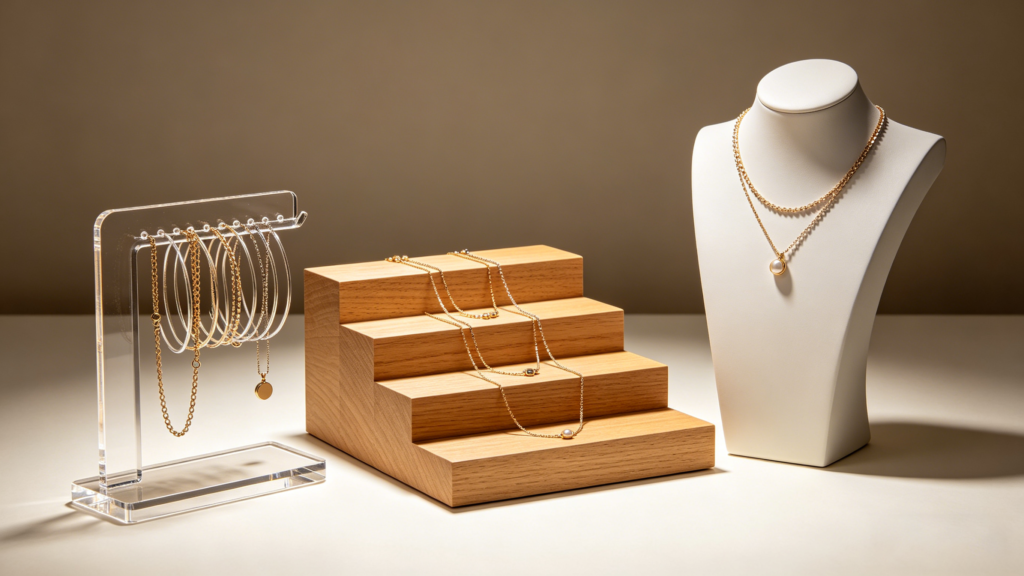
There are three core problems with displaying necklaces. The first is tangling. When two or more chains are placed on the same flat surface, even a small vibration can make them hook onto each other. This is especially true for fine chains, snake chains, and anchor chains – once they tangle, it takes a long time to untangle them. The second problem is obstruction. Many necklace displays look good only from the front. From the side, the chain lies completely flat against the bust, so customers cannot see the side structure of the chain or the details of the clasp. Yet purchasing decisions often require viewing from multiple angles. The third problem is difficulty putting the necklace back. After trying a necklace on, customers find it hard to return it to the perfect display position. When they cannot, the necklace ends up in a heap, which affects the next customer’s experience and increases the time staff spend tidying up.
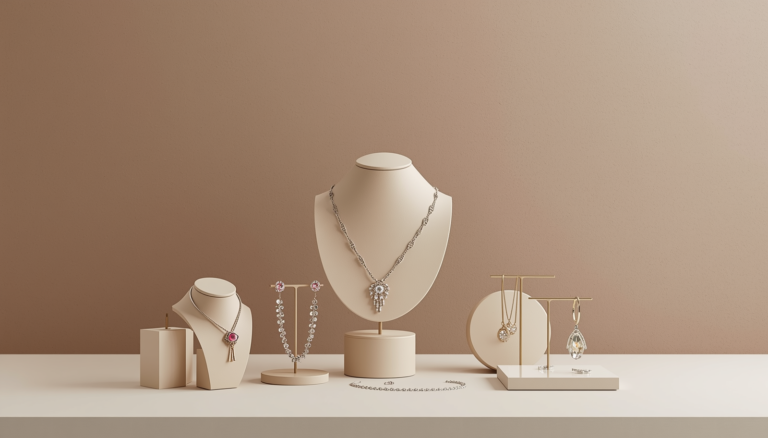
Common types of necklace display props each have their own strengths and weaknesses. A flat tray made of velvet or leather, where the necklace is simply laid flat, is simple, low cost, and does not take up much space. But it tangles very easily. When necklaces are stacked on top of each other, they hide each other. And once a customer picks one up, they can never put it back in the same shape. This kind of display is better suited to low‑price necklaces in storage or as a shipping insert. A standing foam or velvet bust – the half‑body or neck‑only type – has the advantage of simulating real wear, so customers can easily imagine how the piece will look on them. The downside is that long chains tend to tangle behind the bust. To put the necklace on the bust, you usually need to open the clasp and then close it again, which adds an extra step for customers. Busts also take up quite a lot of depth in a display case. Another common issue is that the neck curve of many busts is designed for a standard size, and chains that are too short or too long do not fit well.
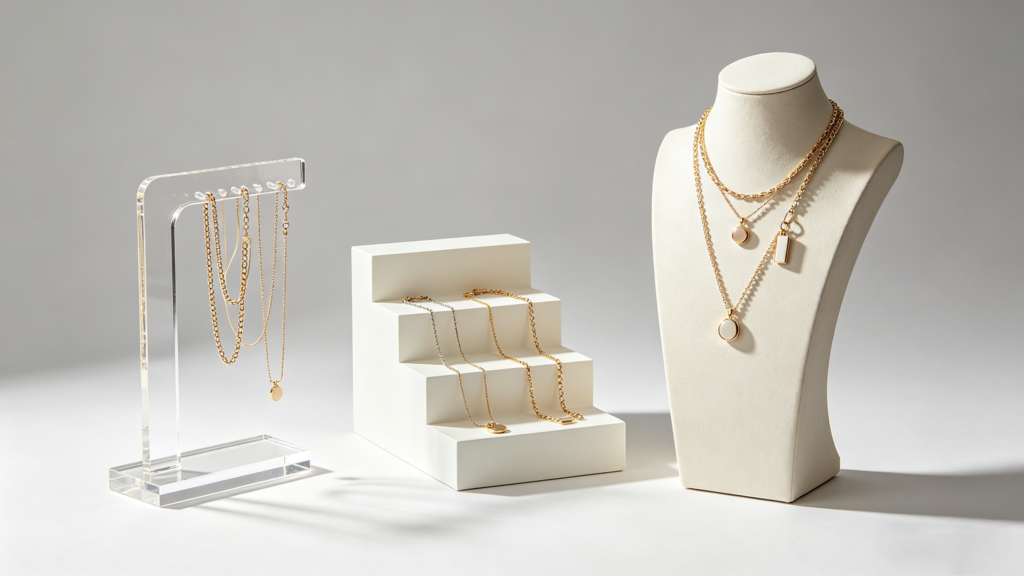
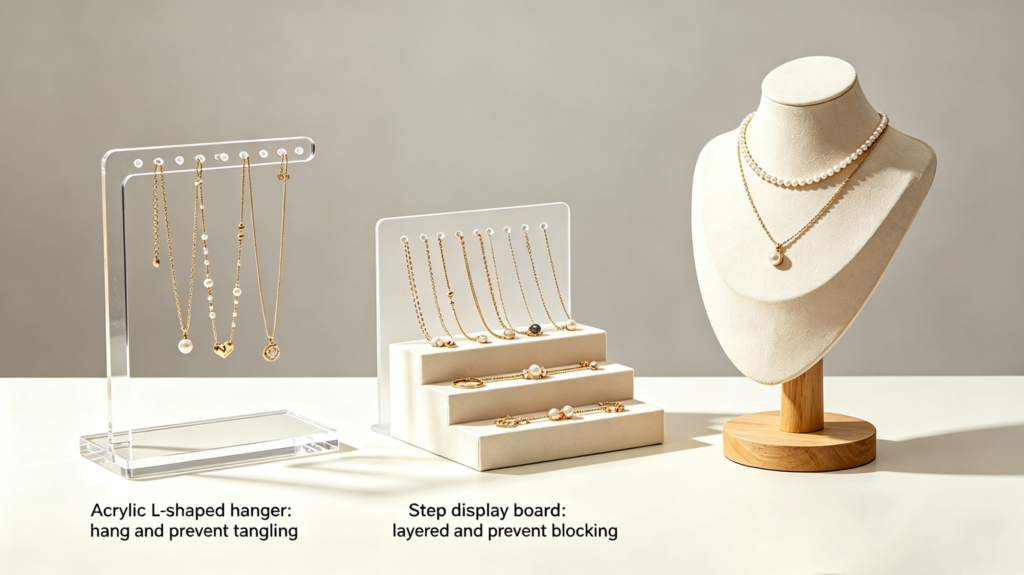
The clear acrylic L‑shaped hanger has become quite popular in recent years. It consists of a vertical panel with a small hook. The advantage is that it is transparent, so it creates very little visual distraction. The chain hangs straight down and does not tangle. The drawback is that the chain can easily slip off the hook, and you can only see the front – the clasp remains hidden. A simple improvement is to add a small ball or a non‑slip silicone sleeve at the end of the hook to prevent the necklace from sliding off. The inclined stepped display board is another approach. It has separate slots on each level, so several necklaces can be shown at the same time without touching each other. The downside is that it requires a fair amount of horizontal space, and bending the necklace to lay it in the slot may create permanent kinks, especially with leather or cord necklaces. This style works best for short necklaces, chokers, and collar chains.
To truly solve the problems of necklace display, several design details are worth paying attention to. First, give each necklace its own space. Do not try to hang multiple necklaces on the same hook or place them tightly together in the same tray. When designing the display, leave at least three to five centimetres between each necklace position to prevent them from hooking onto each other. If you are using a stepped display, make sure the vertical distance between each level is large enough that the chains from the upper level do not hang down and touch the level below. Second, provide a dedicated anchoring point for the clasp. Ninety percent of necklace tangling problems start with the clasp. That small spring ring or lobster clasp acts like a hook and catches onto neighbouring chains. A good solution is to include a small post, a magnetic catch, or a tiny slot on the display where the clasp can be fixed, so it does not swing around freely. Third, use detachable display arms. Many brands want the same base to be able to display necklaces, bracelets, and earrings. Modular, interchangeable accessories are a more flexible answer. One base with three attachments – a necklace arm, a bracelet cradle, and an earring plate – allows you to change the display according to the day’s selection. The arm itself should be adjustable in angle, typically between zero and ninety degrees, to allow chains of different lengths to hang naturally. Fourth, add a positioning groove at the bottom. If the display has a small slot at the base where the pendant or clasp can sit, it will effectively limit the necklace from swinging around. This approach works especially well for a single hero piece. The slot can also be printed with the brand logo, combining function with visual branding.
Different necklace lengths suit different display methods. Chokers and collar chains, which are about thirty‑five to forty‑five centimetres long, work best on a flat stepped tray or a short bust. If you hang such a short chain on a vertical stand, the chain will bunch up near the hook and look messy. When laying them flat, you can gently curve them into a soft arc, but do not bend them sharply. Princess chains and matinee chains, around forty‑five to sixty centimetres long, are the most common length. They are ideal for clear acrylic vertical hangers. The chain hangs straight down, and the pendant floats just above the base. The height of the hanger should be greater than the total length of the chain, so the pendant does not drag on the base. Opera chains and rope chains, measuring seventy to ninety centimetres, are the most prone to tangling. A good method is double‑hook suspension – two support points at the bottom hold the two sides of the chain, letting it form a natural U‑shape. Another option is spiral coil trays, where the chain is laid in a flat oval, with soft dividers between each loop. Extra‑long chains, over one hundred and twenty centimetres, are usually not displayed hanging. Instead, you can fold them back and forth on a multi‑layer display or wrap them around a cylindrical prop to create a decorative art effect.
Two design examples are worth mentioning, just for the ideas. The first is a magnetic necklace stand. A magnet is embedded in the base, and the hook has a corresponding metal plate at its bottom. When you need to display a different length of necklace, you simply change the hook – no need to replace the entire base. When a customer wants to try the necklace, they lift the hook together with the necklace. After trying it on, they put the hook back into the base, and the magnet automatically aligns it, saving the time needed to rearrange the display. The second is a double‑sided transparent display. Because the clasp and back details are often overlooked, this solution uses a clear acrylic double‑sided panel. The necklace hangs in the middle, and both the front and back are transparent, so customers can walk around and clearly see the clasp and the reverse side of the pendant. This is a very small change, but it makes a big difference for high‑end, finely crafted necklaces.
A good display prop should save you worry, not create more. The challenge of necklace display is not simply hanging the piece up – it is keeping it looking tidy, accessible, and attractive throughout the day. A well‑designed display reduces the time staff spend tidying up and increases the time customers spend admiring the jewellery. If you are struggling with tangled necklaces, start by checking three things: do the chains have independent space? Is the clasp fixed in place? Is it easy for customers to put the necklace back? Solve these three problems, and the experience of displaying necklaces will move to a much higher level.